
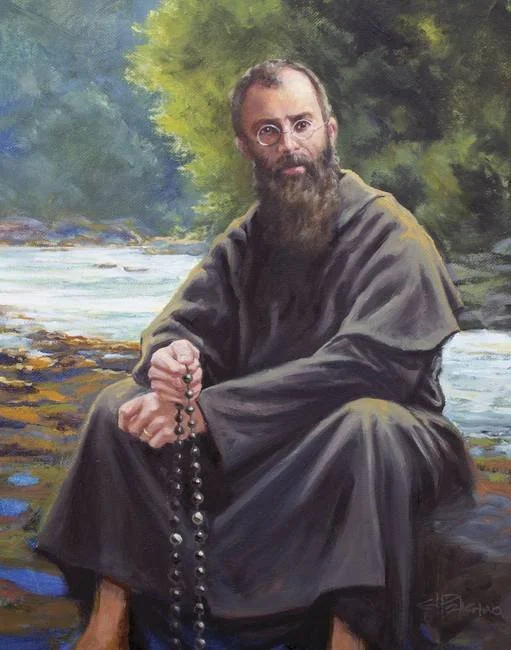
The Life of Saint Maximillian Kolbe
The legacy of St. Maximilian Kolbe (1894–1941) is often centered on his final days in Auschwitz, yet that sacrifice was the logical conclusion of a life built on a prophetic choice.From his youth in Poland as Raymond Kolbe to his canonization in 1982, his life was a consistent pursuit of total consecration to the Virgin Mary, whom he referred to as the "Immaculata."
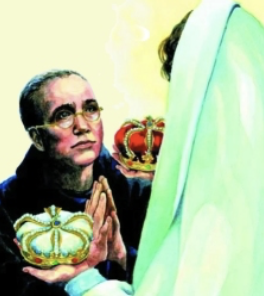
The Dual Crowns and the Knight’s Vow
The trajectory of Kolbe’s life was set by a childhood apparition of the Blessed Mother. When offered the white crown of purity and the red crown of martyrdom, his response—"I choose both"—rejected the idea of a half-hearted faith. This wasn't just a pious sentiment; it became the blueprint for his career. After joining the Franciscans and earning a doctorate in theology in Rome, Kolbe founded the Militia Immaculatae (M.I.) in 1917. He saw the world through the lens of a spiritual battlefield, and he viewed himself and his followers as "Knights" whose weapon was the printing press.
The Industrialization of Faith
Kolbe was a pioneer of religious mass media. He believed that if the "enemies of the Church" could use modern technology to spread error, then the Church must use even better technology to spread the Gospel. He founded the "City of the Immaculata" (Niepokalanow) near Warsaw in 1927. This was no traditional monastery; it was a sprawling industrial complex dedicated to the production of The Knight of the Immaculata magazine.
By 1939, the publication had a circulation of nearly one million copies. Kolbe oversaw a community of over 700 friars who were trained as printers, editors, and technicians. His ability to manage such a massive organization while suffering from advanced tuberculosis—at times having only one functioning lung—was regarded by many as a miracle of endurance.
In 1930, Kolbe took his mission to the Far East. In Nagasaki, Japan, he founded "Mugenzai no Sono" (Garden of the Immaculata). His choice of location for the mission was criticized at the time, but it famously survived the 1945 atomic bombing because a nearby hill absorbed the heat and shockwaves.
When he returned to Poland, he found his homeland on the brink of collapse. Following the 1939 German invasion, Niepokalanow became a center for relief work. Kolbe did not shy away from the political realities; his publications continued to provide a moral compass for a suffering Polish population. This led to his first arrest in 1939 and his final arrest in February 1941. He was eventually sent to Auschwitz, where the Nazis sought to strip him of his identity and reduce him to a number: 16670.
The Japanese Mission and the Nazi Invasion
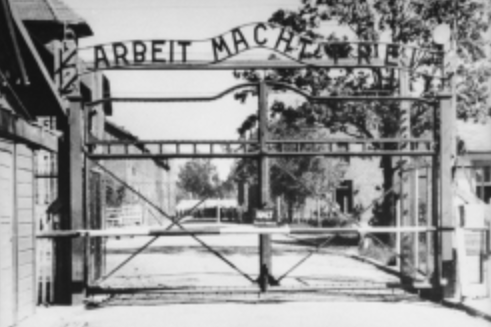
The Starvation Bunker: A New Liturgy
The final act began on July 29, 1941. After a prisoner escaped, the commandant of the camp, Karl Fritzsch, announced that ten men would be starved to death in retaliation. When Franciszek Gajowniczek was selected and began to sob for his family, Kolbe broke the ranks. In the rigid hierarchy of the camp, such an action was usually met with immediate death, but Kolbe’s calm demeanor disarmed the commandant. "I am a Catholic priest," Kolbe said, "and I wish to die for that man."
The ten condemned men were stripped and thrown into a lightless basement cell in Block 13. Typically, these cells were filled with the screams of the dying. However, according to the guard's accounts, this time the cells rang with the sound of the Rosary and Gregorian chant. Kolbe acted as the shepherd of the condemned, walking them to the threshold of death. After two weeks, only Kolbe and three others remained alive. On August 14, 1941, the guards ended his life with an injection of carbolic acid. He was 47 years old.
At his canonization in 1982, Pope John Paul II (a fellow Pole) declared Kolbe a "Martyr of Charity." Crucially, Franciszek Gajowniczek, the man Kolbe saved, was in the crowd, having survived the war to tell the story. Today, the work of the Militia continues globally, and Kolbe is recognized as a patron saint of journalists, political prisoners, and the pro-life movement. His life remains a testament to the idea that even in a "factory of death," the individual human will, fortified by faith, can choose love.